May 09, 2022
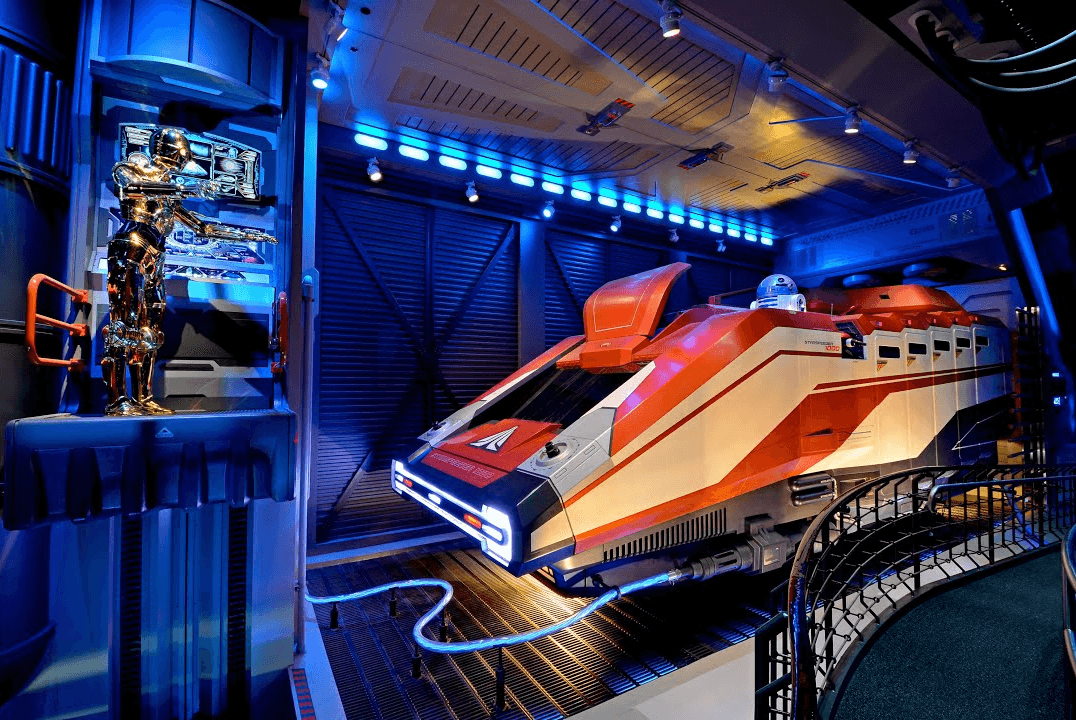
Thirty-five years ago, Star Tours opened at Disneyland, and its first guests hopped aboard Star-speeders for an out-of-this-world adventure. An R2D2 droid swooped people on a flight drenched with adventure and excitement. The ride featured iconic Star Wars locations like Endor, Tatooine, and Mustafar. But what made Star Tours an everlasting gem in the House of Mouse was not just the ride itself but the immersive experience provided for those waiting in line for the ride. Disney successfully and revolutionarily designed an immersive world-building and audio-visual experience for the users within a queue.
As guests queue for the ride, they are guided through an intergalactic airport terminal. Many elements are integrated to simulate a non-real experience with exactness. On one elevated panel, animatronic aliens and robots pace around and space-themed music tantalizes the senses of the visitors. On another, they are eagerly greeted by C3PO, who informs them about the exciting prospects of traveling through different planets and biospheres. Beeping robot sounds, exotic accents, and space-themed music tantalize the visitors' senses. Next to the quirky machine booms the large Star-speeder 3000, parked in a metallic space garage filled with beeping sounds and blue lights. This interstellar vehicle is strategically lighted to attract the visitors’ attention as they flock around it to take multiple photos. As passengers pour in and move through the corridor, they are greeted by yet another strange robot directing them to different areas. This droid seems to have a big character as it points to individuals in the corridor often making jokes at their expense sending the rest of the crowd into a laughing frenzy. Nicknamed by park-goers as Bebop for its unusual sounds and head movements, this droid not only engages the audience but also stalls the lines, often for hours, forcing Disneyland's management to hurry people through the area. In a dimly lit space, the droid is surrounded by a million glowing buttons and futuristic panels imitating a far-away civilization booming with innovation and technological advancement.
At Disneyland, Star Tours has transformed the passive pain of killing time into an interactive experience of enjoyable aesthetics. Other rides struggle with disinterested and agitated crowds who are stuck in long lines awaiting their turn, whereas the Star Tours spaceport is a surreal environment that transports individuals into the Star Wars dimension.
Park-goers’ minds wander the highly curated space of Star Wars memorabilia whilst forgetting about the pain of waiting for the ride. Instead of the common sighs and frustrating ticks that accompany the mindset of those in a queue, we see riders photographing the line-waiting experience. In this context, waiting can be analyzed as a psychological state. Voltaire once said, “We never live; we are always in the expectation of living through the act of waiting.” The majority of queues any one individual experiences in their lifetime are illuminated through Voltaire’s lens. An expectation of what is to come next; waiting for the payoff. This psychological state can be defined as a mixture of boredom and frustration. Boredom with the lack of exciting stimuli and frustration at the anticipation of a memorable experience marred by the act of waiting. In this world of instant gratification, the common queuer’s expectation is not meeting their reality. Disney Parks observed this phenomenon and revolutionized the queueing experience by meeting the users at their psychological pain points of boredom and frustration. They took the loss of waiting and transformed it into a multidimensional aesthetic experience meant to stimulate those in line. This reduces experiential pain points and allows for increased positive associations with the ride and brand while also building the world or story of the ride within the line goer’s mind.
This may seem like an easy change, but it requires a developed sensitivity to the audience. Empathy is the key to a more enriching experience and psychology is the mechanism by which it can be analyzed. In that format, it's a matter of Neuro-design, of trying to understand the psychology of the people waiting but also their boredom or frustrations and how design can counter those negative associations. This requires human-centered design thinking from the point of view of those waiting in line by the people providing the services.
Many people encounter at least one queue and the painstaking experience of waiting that comes along with it weekly. If the queue moves quickly, it's soon forgotten.But alas, a slow line can seem to last forever and often puts a drag on the rest of our day. Lost time. What separates an engaging queue from a bad one is the user experience design that accompanies it. And while waiting time is often meticulous to cut down, perception can be altered with good line design and management. Indeed, the golden standard of design and management can be found in theme parks like Disneyland. Waiting in lines is such an integral part of that experience that theme parks aren't afraid to invest. Disney's Operation Command Center, located under the Disney Castle in Anaheim, monitors and manages waiting times and queue flows. Data from this facility first supplemented the idea for an elaborate wait experience for park-goers at Star Tours that continues to render positive feedback and fandom to this day.
In an attempt to combat symptoms associated with waiting like stress, boredom, and often anxiety, distractions are built-in by designers. "Star Tours is a queue factory, and yet everyone is happy," says Dr. Larson, a Massachusetts Institute of Technology researcher specializing in queuing and waiting from a psychological perspective1. The waiting design of Star Tours is so successful that parents and children can happily stand in line for more than an hour to experience a five-minute ride — a pretty remarkable feat. And, of course, the capacity of the queue is carefully calculated to balance customer satisfaction with profits. So far, Disney's strategy at Star Tours appears to be working. Disney's parks have continued to implement the design decisions executed at Star Tours and incorporated them into other rides attempting to set new visitor records.
Walt Disney Imagineering constructs Star Tour's waiting line with the same care used for the attraction itself, adding interactive features, and performances, constructing elaborate pieces of memorabilia, and giving guests plenty to do. Implementing experience design for queues keeps guests from measuring the passage of time, which is typically their primary behavior. If guests increase their mental workload, if they occupy their minds, they are no longer keeping track of time spent waiting, and, therefore, the queue seems shorter than it is. In this vein, designers have found their means to the act of killing time, providing an experience of curated aesthetics. Time lost becomes experience gained.
Works Cited (MLA)
1.Larson, Richard C.
“Perspectives on Queues: Social Justice and the Psychology of Queueing.” Operations R esearch, vol. 35, no. 6, 1987, pp. 895–905,