April 16, 2023
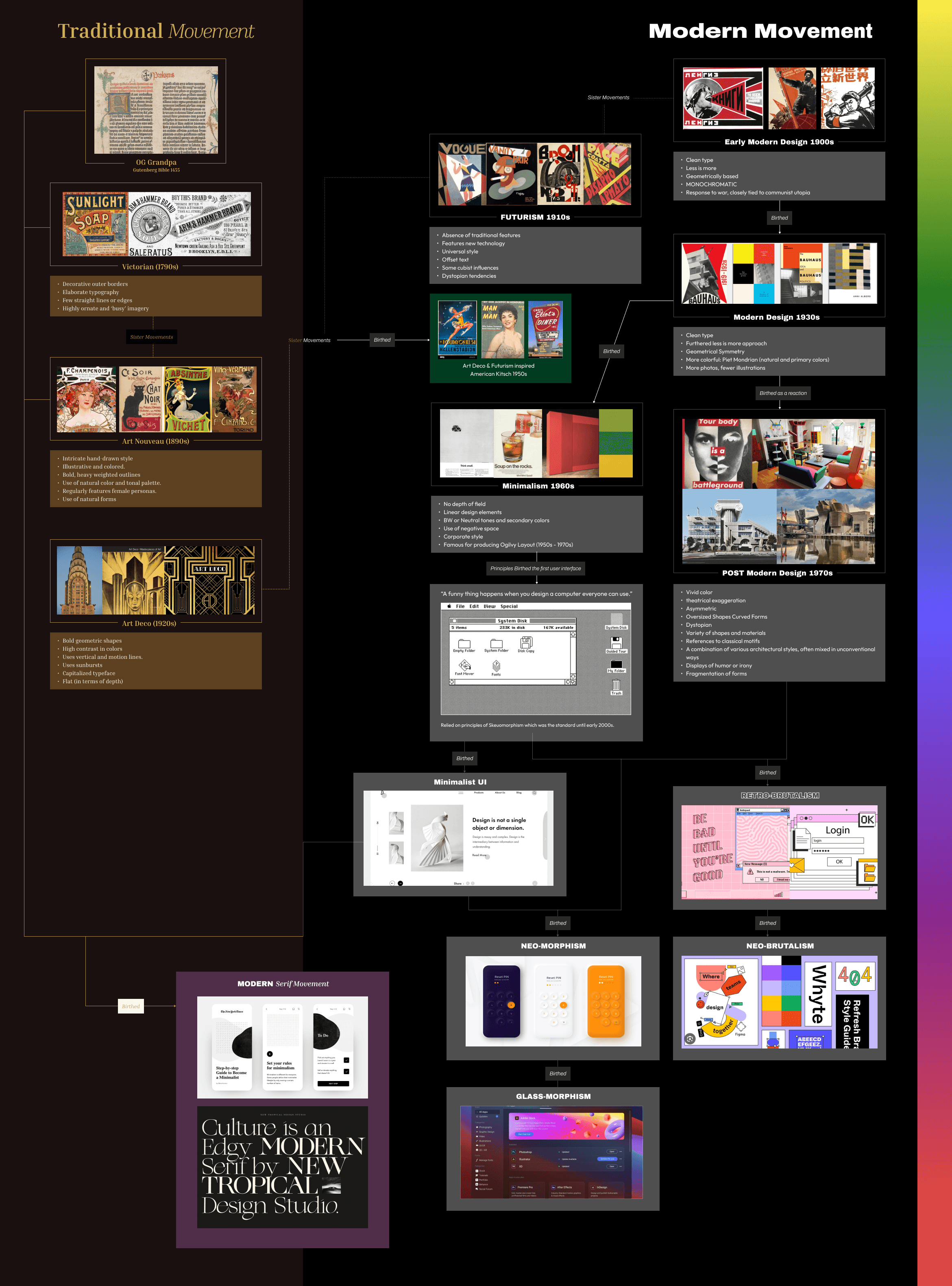
Rather than treating design movements as isolated styles, I created this chart to show how values, constraints, and philosophies migrate across time: from printed manuscripts to posters, from industrial graphics to digital interfaces.
Traditional Movement: Design as Craft and Ornament
Early design was inseparable from craftsmanship.From illuminated manuscripts and Victorian packaging to Art Nouveau and Art Deco, design was deeply ornamental, expressive, and labor-intensive. Visual hierarchy was achieved through embellishment—borders, flourishes, hand-drawn type, and symbolic imagery.
These movements emphasized:
Detail over efficiency
Decoration as meaning
Design as a reflection of culture, class, and tradition
Even Art Deco, which introduced geometry and structure, retained a sense of richness and spectacle. Design wasn’t trying to disappear, it wanted to be seen.
Modern Movement: Function Takes the Lead
As society industrialized, design followed. Early Modern and Bauhaus-era thinking marked a philosophical shift: form follows function. Ornament was stripped away in favor of clarity, structure, and reproducibility. Typography became cleaner, layouts more systematic, and color palettes more restrained.
Modernism reframed design as a tool:
Communication over decoration
Systems over individuality
Universality over cultural specificity
By the 1930s–1960s, this thinking matured into minimalism—especially visible in Swiss design and later corporate branding. Design aimed to be neutral, efficient, and almost invisible.
Postmodernism: Breaking the Rules on Purpose
Postmodern design emerged as a reaction to modernism’s rigidity. Instead of clarity at all costs, postmodernism embraced:
Visual tension and contrast
Humor, irony, and exaggeration
Fragmentation and asymmetry
Color returned. Playfulness returned. Meaning became layered again. Design no longer pretended to be objective—it acknowledged its own subjectivity. This era made space for experimentation and cultural commentary, even if it sometimes sacrificed usability in the process.
Digital Minimalism: When Design Became an Interface
As design moved onto screens, new constraints reshaped everything. Early digital interfaces borrowed heavily from minimalist and Swiss principles—not because they were trendy, but because clarity and legibility were necessary for usability. Limited resolution, early operating systems, and performance constraints pushed design toward simplicity.
Minimalist UI isn’t about aesthetic preference, it’s about:
Reducing cognitive load
Prioritizing hierarchy and affordances
Designing for interaction, not just appearance
In many ways, this was modernism reborn through technology.
Contemporary Movements: Emotion Returns
Recent digital design trends—neomorphism, glass-morphism, neo-brutalism—signal another shift. These styles reintroduce emotion, texture, and personality into interfaces:
Neomorphism plays with depth and tactility
Glass-morphism explores translucency and layering
Neo-brutalism rejects polish in favor of boldness and honesty
What’s interesting is that none of these are truly new. They remix historical ideas—ornament, contrast, materiality—within modern technical constraints. Design keeps circling back, but never to the same place.
Why This Map Exists
This chart isn’t meant to be exhaustive or prescriptive. It’s a thinking tool.
As a designer working across data, systems, and interfaces, I often find that the most compelling solutions don’t come from following trends—but from understanding where those trends come from.
When you recognize that today’s UI patterns are descendants of centuries-old ideas, design feels less like chasing novelty and more like participating in an ongoing lineage.
Design doesn’t move forward in straight lines.
It branches, reacts, remembers, and repeats: just with new tools.